
Picasso Film is in Italy, a little past the halfway point of the Italian block of WHERE BLOOD RUNS, our co-production with S.D. Cinematografica of Rome. Max Serio directs. Paolo Sodi is on camera. Dr Jessica Clarke leads the investigation on screen, walking the sites and putting the questions to the people who know them best.
We built the itinerary backwards. Everyone knows where this story ends: in an arena, in front of a crowd. We wanted to arrive there last — and to spend the days before it working out where the appetite came from.
The Etruscans first
So we started in Tarquinia, ninety kilometres north of Rome and several centuries ahead of it.

The Etruscans were here long before Rome was a serious proposition, and when Rome did arrive it took a great deal from them — including, the evidence suggests, the habit of marking a funeral with a fight. We filmed on the platform of the Ara della Regina, one of the largest Etruscan temples known, now a rectangle of worn stone in a meadow, and we spent two days underground in the painted tombs.
Those tombs are the reason to come. Two and a half thousand years of damp, and the paint is still on the walls: dancers, banqueters, pipe players, wrestlers, men with weapons. People at the top of their lives, painted for the dead to look at. We were granted access to film them, which is not a small thing, and we are grateful to the park for it.

A city for the dead
Then Cerveteri, and the Banditaccia necropolis.

You walk down a cut in the tufa between mounds taller than you are, and after a few minutes you stop reading it as landscape and start reading it as a street. Which is what it is. Banditaccia has junctions, kerbs, doorways, plots — house-shaped tombs with beds carved into the rock inside them. The Etruscans built their cemeteries the way they built their cities, and gave the dead addresses.
Tarquinia and Cerveteri are inscribed together on the UNESCO list, and standing in one straight after the other, you understand why. They are two halves of one idea.
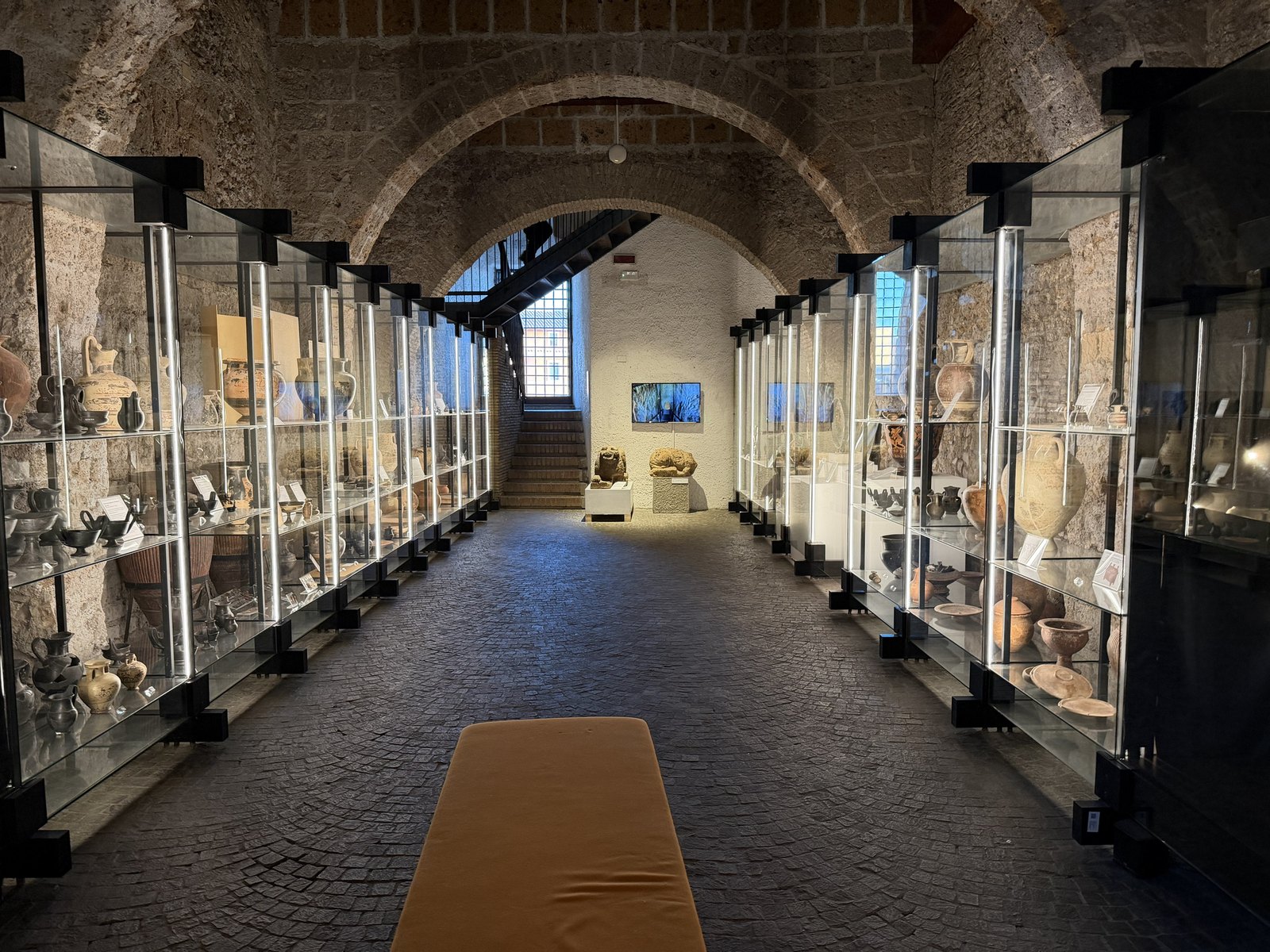
The Archaeological Museum of Cerveteri cleared the building for us, which meant we could light it properly and work without a clock running.
Crossing over
From there the series crosses into the Roman world, and we crossed with it — to the civic museum in Viterbo, and then to Ferento, a Roman town on a ridge with its theatre still standing.
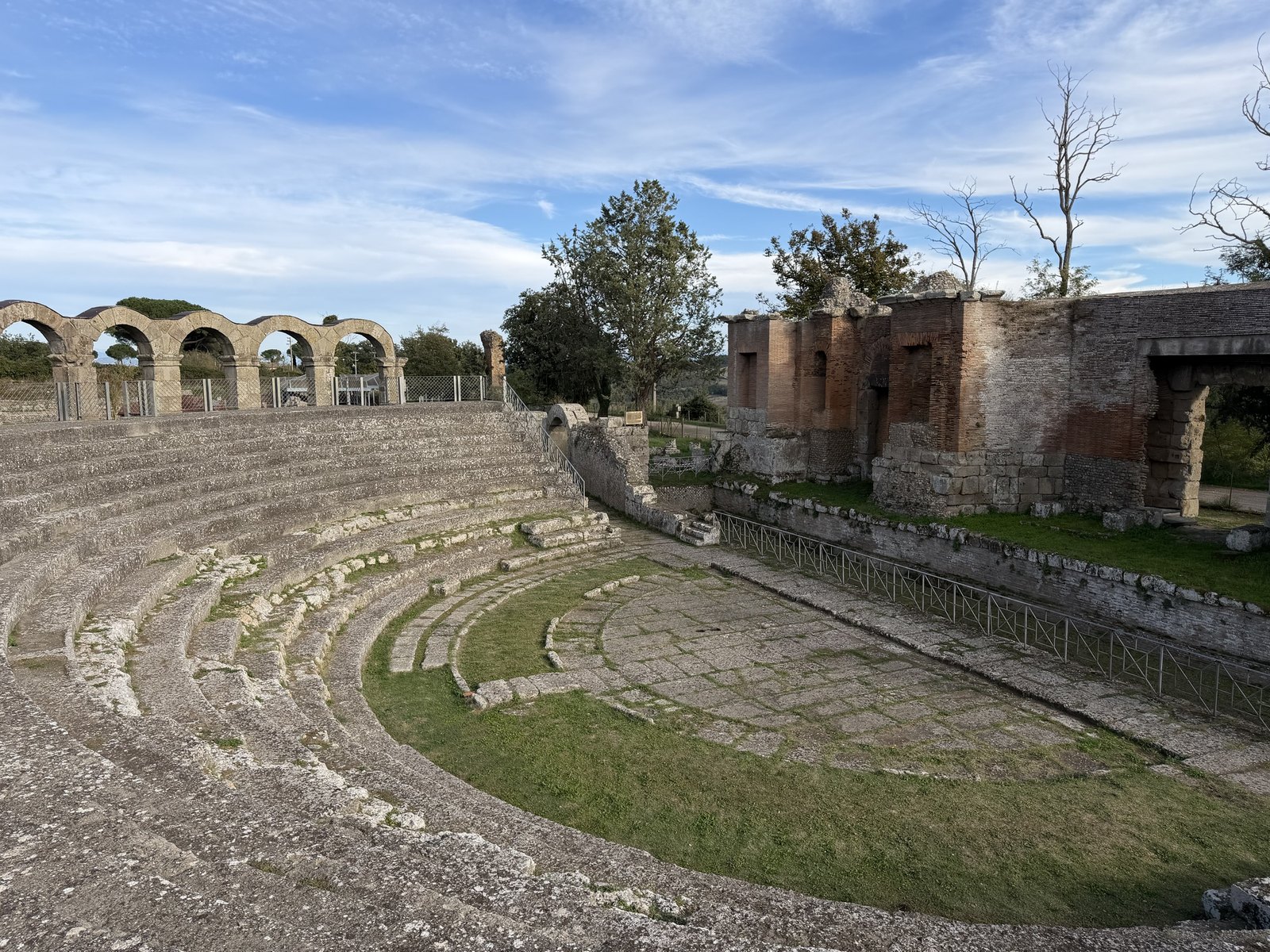
Ferento is the hinge of the film. It is a beautiful building, built for plays, and like many of its kind it was later pressed into service for something louder. The arcade is intact; you can stand in the orchestra and work out the sightlines for yourself. We gave it most of a day.
The road
Then the Appia.
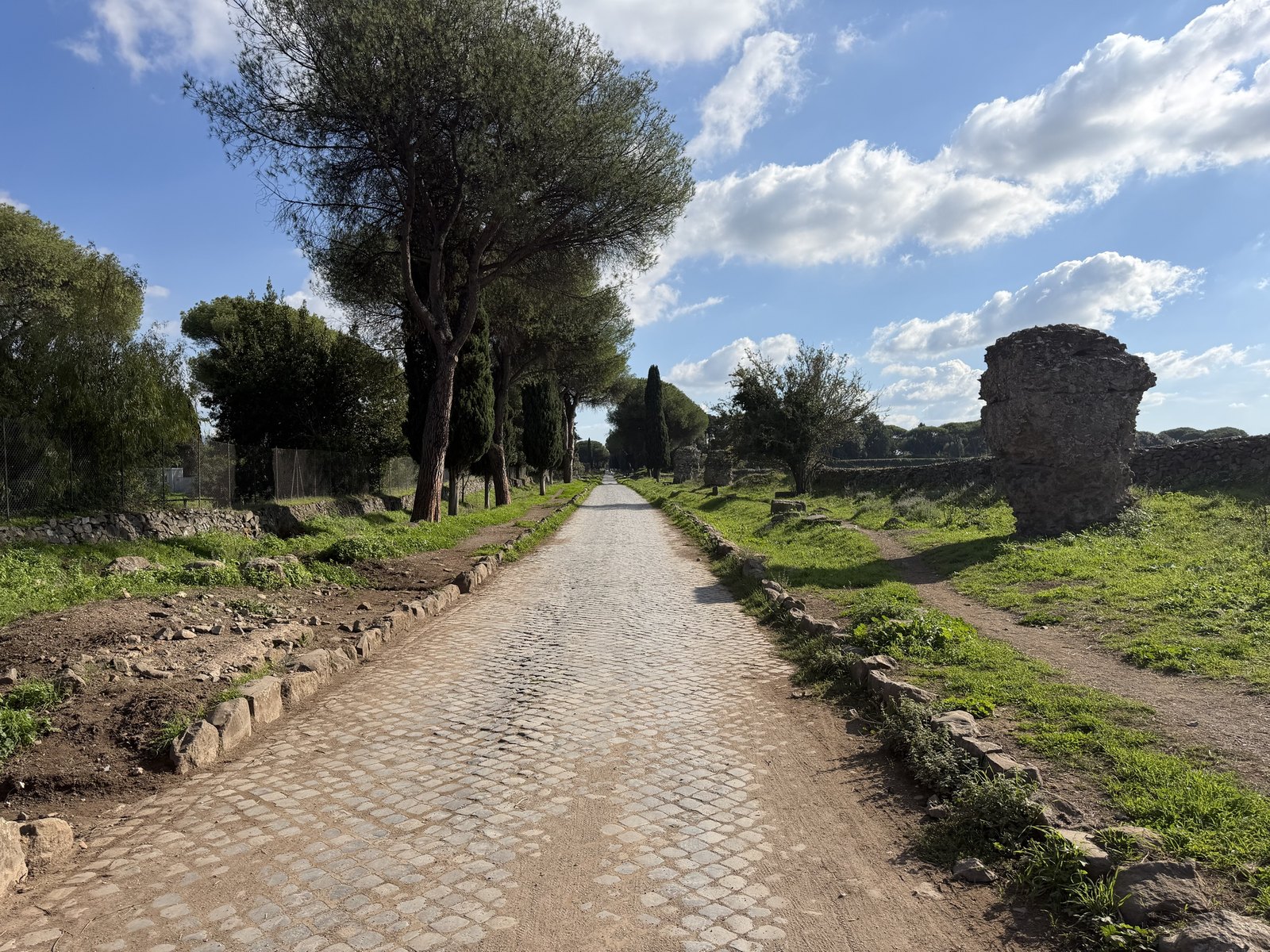
If you want to understand the story we are telling, walk the old basalt for an hour. It runs dead straight to the horizon, and it does not care what you think of it. This is the road to Capua, where it began, and it is the road along which it ended: Appian puts six thousand crosses on it, roughly one every thirty metres, the whole way back to Rome. No trace of them has ever been found, which is its own kind of fact.
We also filmed at a run of villas and bath complexes along the road, where the other side of the same economy is very easy to see. The mosaics are extraordinary. Somebody laid every one of those tesserae.
Rome
And then, last, Rome.
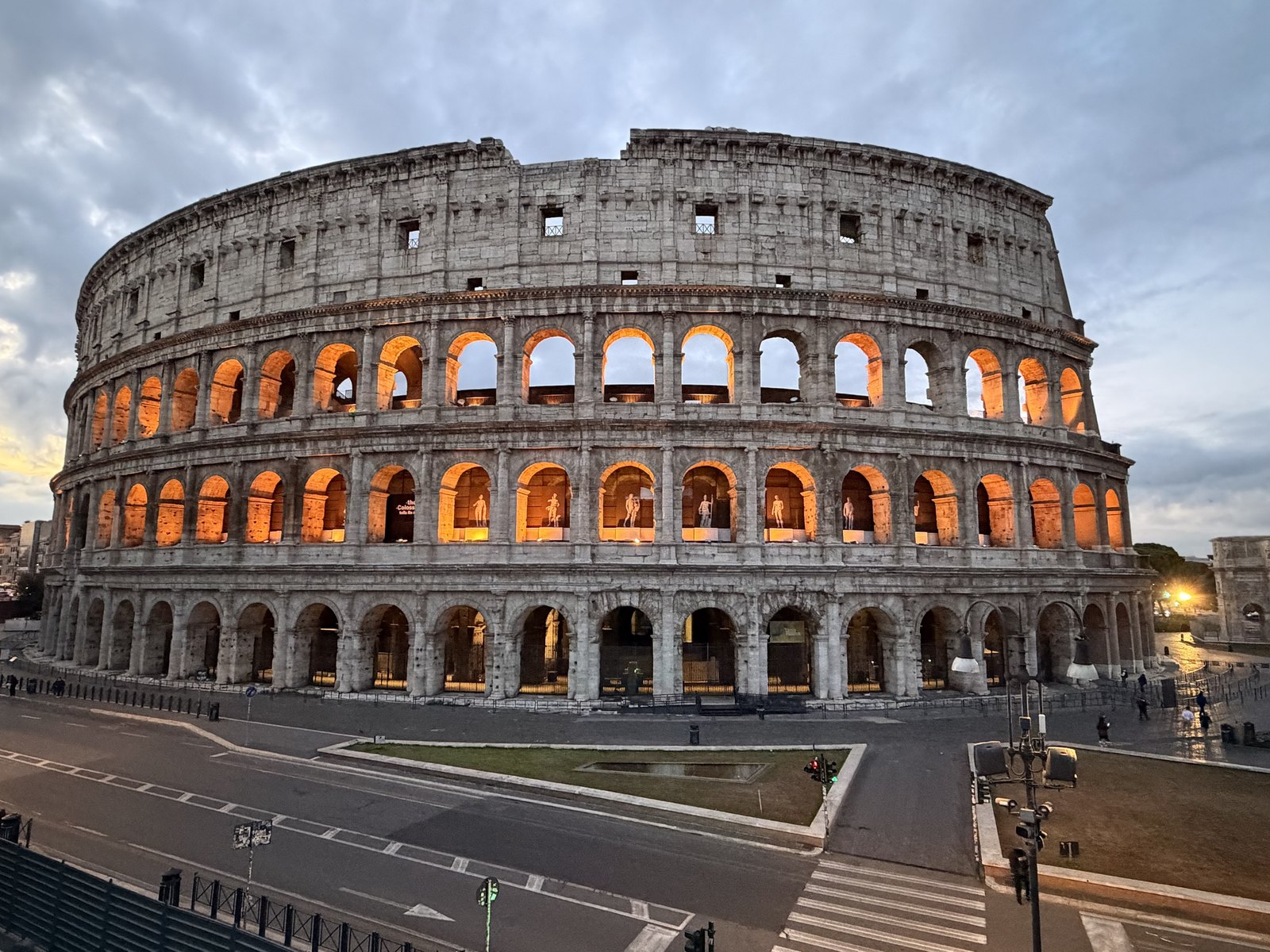
We shot the Colosseum before the city was up, and the Theatre of Marcellus in the afternoon. The two buildings sit a short walk apart, and between them they tell you most of what you need to know: Rome kept its drama and its blood in separate houses, and there is no mistaking which one it built bigger.


The names
And then, in the Salone of the Galleria Borghese, the floor.
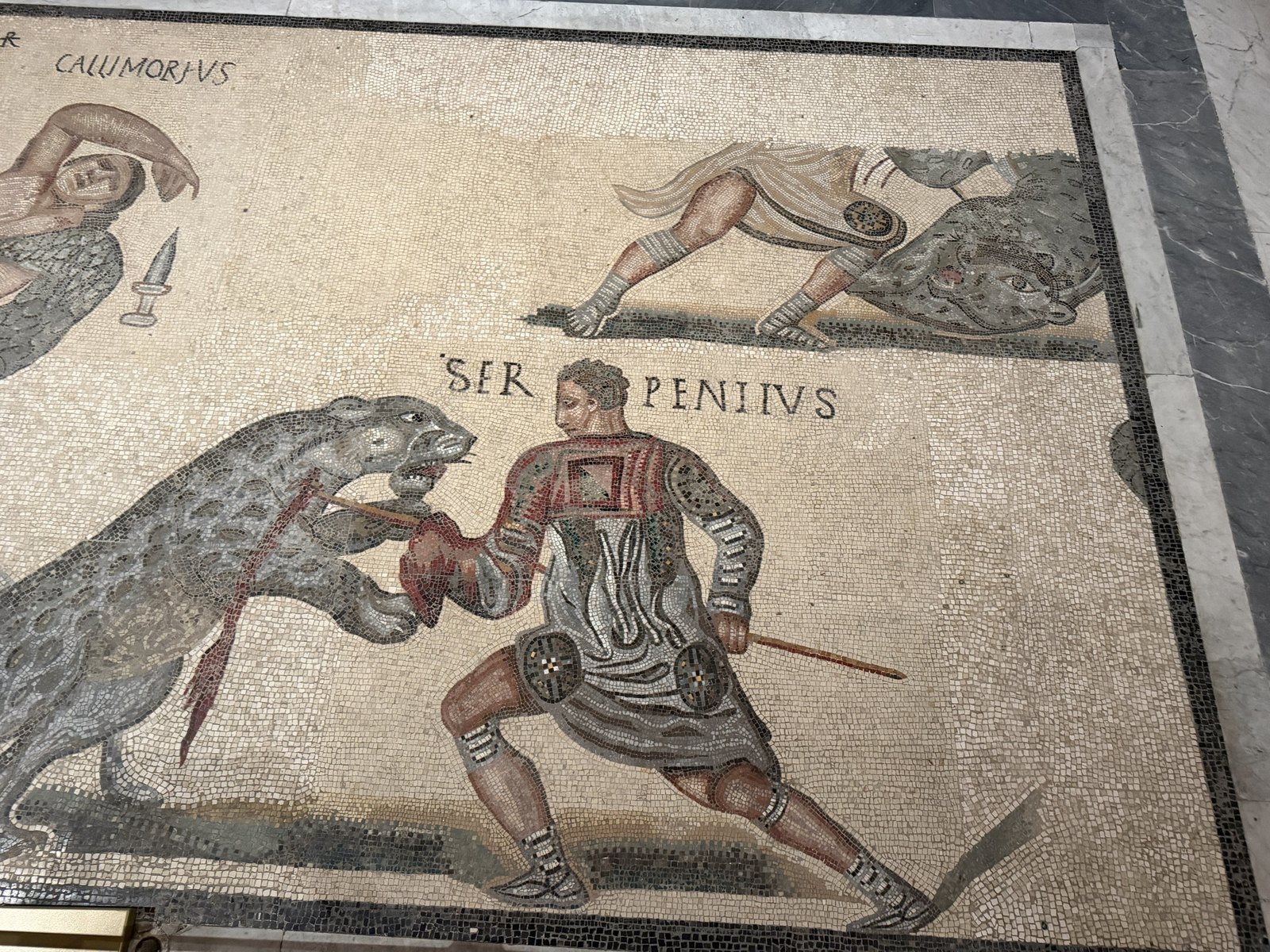
It came out of the ground in 1834, on the Borghese estate at Torrenova along the Via Casilina, and it was laid in the first half of the fourth century. It shows gladiators and venatores at work. Beside each figure, set into the tesserae, is a name.
CALLIMORFVS. SERPENIVS. BACCIBVS. ASTACIVS.
And beside ASTIVVS — flat on his back, shield still strapped to his arm — a small circle with a line through it. Theta, for thanatos. It marks a man who died in that fight.

This is the thing we came for. Everything else on this itinerary is architecture, and architecture is easy to admire: it is very good at hiding who paid for it. A tomb is a room. A theatre is a shape. An amphitheatre for fifty thousand people is an engineering achievement before it is anything else.
The floor does not permit that. It gives you the names, and then it tells you which of them did not go home. Seventeen hundred years later we are still reading them out loud.
Still going
Five shooting days left. We will have more to say when the block wraps.
WHERE BLOOD RUNS is an Italian–Czech co-production between Picasso Film and S.D. Cinematografica. Directed by Max Serio. Director of photography Paolo Sodi. With Dr Jessica Clarke.